| Completed in June of 1999, the Musical Instrument Engineering Quiet Room is now in full operation. Inside Dimentions measure 7'10" W x 7'10" D x 7"2" H. The walls are constructed of drywall and plywood framed with staggered studs. Laced inbetween these studs is lead imprenated vinyl sheeting. Finally, the walls and ceiling of the inside of the room are covered with 3" Sonex acoustical foam. This construction is designed to minimize high frequency reflections inside the room, and block low frequency transmission through the walls. A schematic of the wall design is shown in Figure QR-1. |
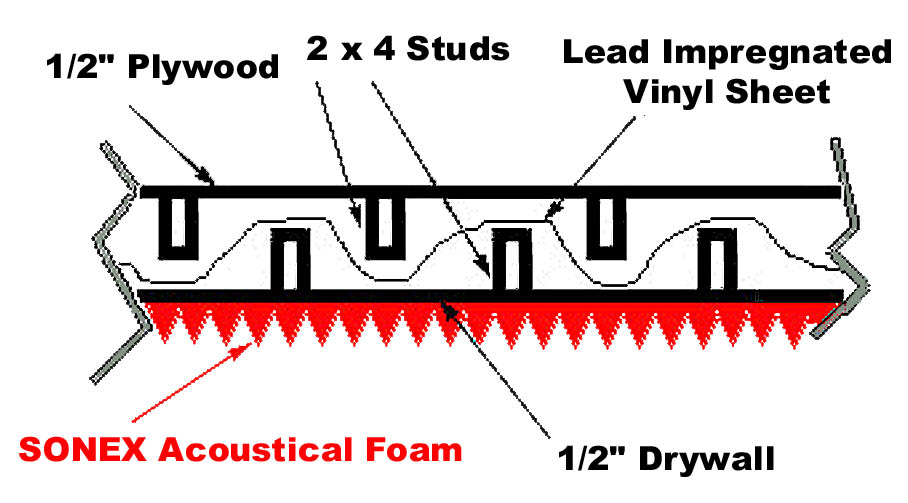
Figure QR-1, Wall Schematic |
| Insertion point measurements were taken to determine attenuation of noise due to the room. This was done by producing white noise at the center point of the room and measuring sound pressure levels at octave band increments before and after the room was built. The level of attenuation is displayed in Figure QR-2. |
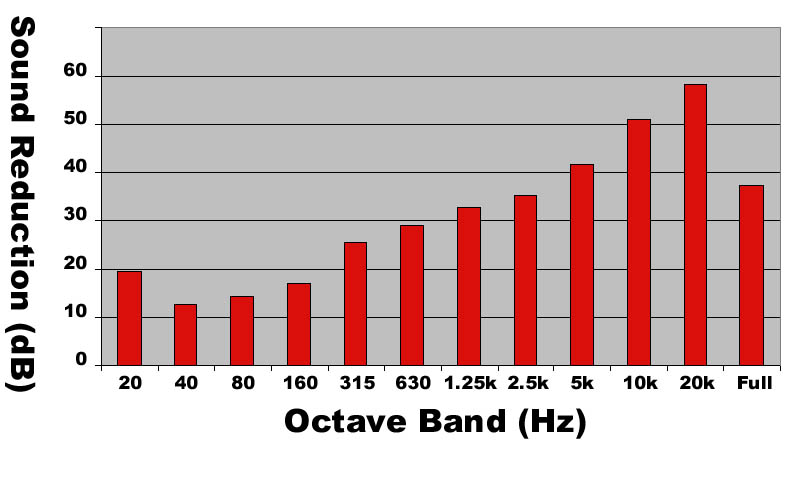
Figure QR-2 |
| Reverberation Time (Tr) for the room was determined by estimating the time required a 60 dB decay of an impulse sound. A balloon popping was used as the impulse sound source. Tr was determined to be 0.05 seconds for the high frequency modes in the range of 500 Hz and higher. For low frequency modes (<500 Hz), Tr = 0.5 seconds was estimated. The wave shape of the impulse sound and extrapolations of decay are presented in Figures QR-3 (high freq. modes) and QR-4 (low freq. modes) |
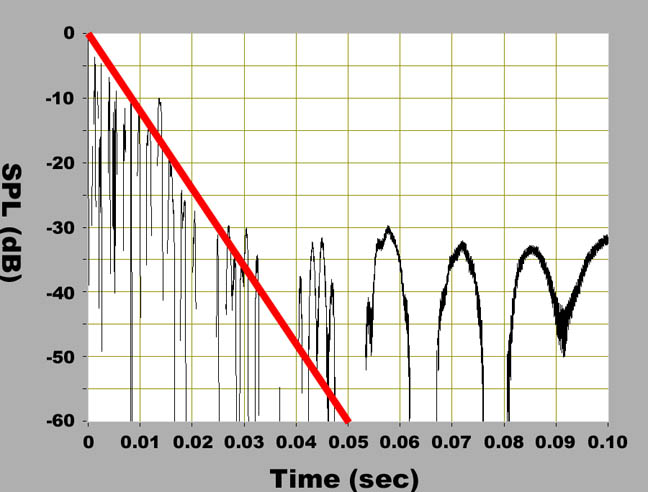
Figure QR-3, High Frequency Decay Time |

Figure QR-4, Low Frequency Decay Time |
|
|
Photographs of the room exterior are presented in Figure QR-5 |
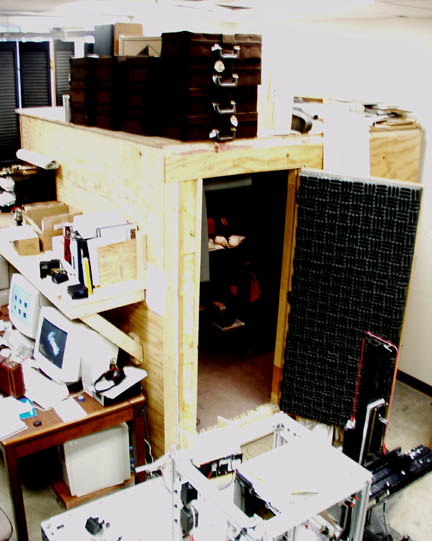
Figure QR-5, Quiet Room Exterior |